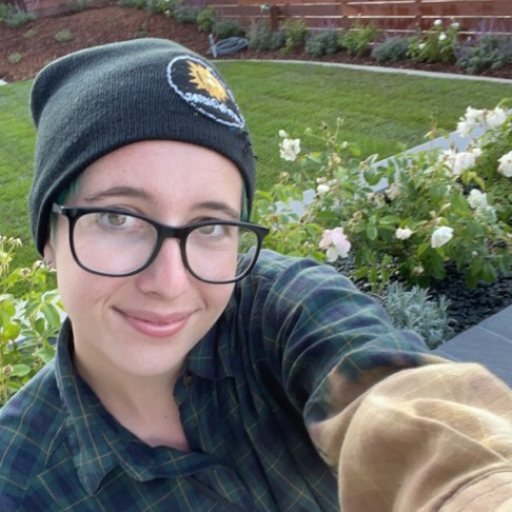
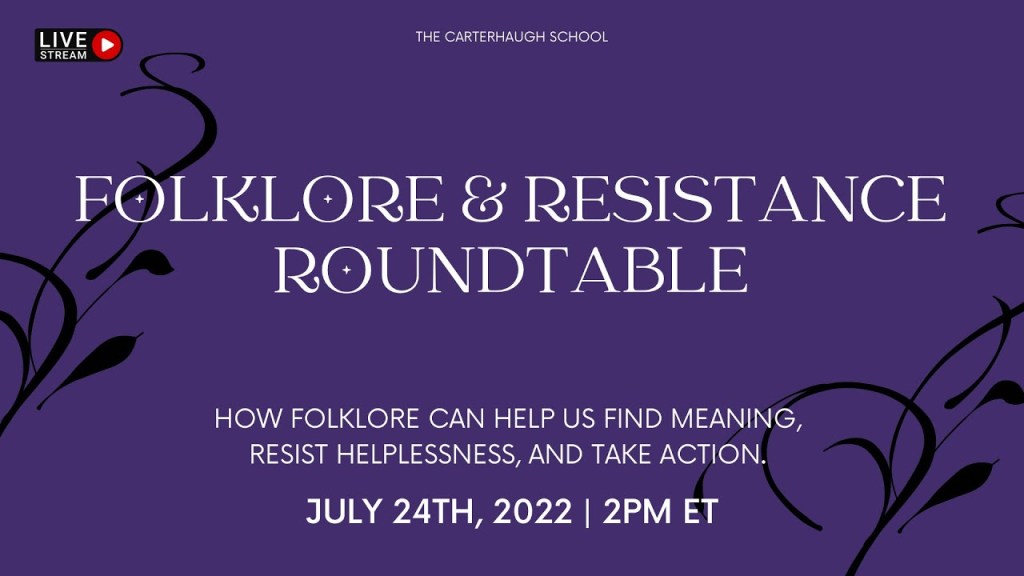
This is the written version of a presentation I was invited to give at a roundtable hosted by The Carterhaugh School. The subject centered on Folklore & Resistance. delivered on 24 July 2022.
“Thank you for that introduction! Hello attendants! I feel your presence and appreciate you all taking your time out of your day to share some space with us virtually and listen to these wonderful speakers today. I am beaming to you today from the ancestral and contemporary lands of Shawnee, Potawatomi, Delaware, Miami, Peoria, Seneca, Wyandotte, Ojibwe and Cherokee peoples, but what is more commonly known today as Columbus, Ohio. I am here today to get us thinking about the connections between folklore and ecology as they inform our senses of community. I began my interest in the study of folklore as an undergraduate searching for answers to the parts of building relationships with people I didn’t really understand. Why did people have opinions on how long Christmas lights should be up? Or how text speak, emojis, or playful language added to my ability to communicate with friends, but did not necessarily work with my parents or colleagues, and how should I know which to choose? Why should I believe certain authorities over others in regards to my daily medical care, as I was in an environment that paid respect and credibility to homemade remedies? I began to see folklore facilitating questions about normative behaviors and power. While I first thought folklore was only about fairies and costumes and dancing, it was the answers I began to find to these questions through this discipline that led me to stay. Now, I see folklore as a tool of resistance to isolation and helplessness, because it centers the little creative ways we express our relationships with one another.
Fast forward to today, I have expanded on these early questions into thinking about the formation of community and our responsibilities to it, particularly in connection to more-than-human beings and ecology. Ecology is all about noticing and describing relationships between different organisms and their physical environments. These relational networks influence the movement of ecosystems, which we are always part of, no matter how intentional or conscious our contributions to it. When we take a daily walk, we may carry unsuspecting pollen to other plants for fertilization. When we spend time with our pets we learn more about how they see the world, and how they in turn shape your shared space, inside and outside the home, uniting and expanding boundaries of home. I define folklore in my work today as the creative communication of everyday life. It is the skull emoji you type instead of “haha” or “lol” (which both indicates you died of laughter and also are probably Gen Z or spending time with them). The TikTok Plant Tour you made to share with your friends because you became a plant parent overnight like so many others during the pandemic, hoping to bring a little more life and care into your home. These two disciplines come together for me as an interest in the expressions we share between ourselves and others of all kinds in small, everyday interactions, which shape our sense of self and participation in community.
A roundtable on folklore and resistance asks us what we are resisting in the first place. A collective sense of helplessness, anxiousness, and isolation seems to be at the forefront of feeling conversations these days. The causes are seemingly unending, and you can basically open up any social forum online and get caught up on listicles, trending hashtags, and news that will either deepen those feelings for you, or give solutions and ideas and directions and actions and you kindof just end up in an entangled mess sometimes, looking at your screen, interacting with hundreds of people and never quite feeling seen. I dont want to linger on the isolation or helplessness to act we may feel in that space, but rather notice and wonder how thinking with folklore and ecology might shake up our senses and help us engage more actively with our world and facilitate our happiness, joy, and confidence in our ability to simply be people.
Folklore helps us find meaning in the seemingly mundane – the things we do every day that make our worlds, and look more and more beautiful the closer you lend the microscope. For me, the connections between folklore and ecology create opportunities for resistance through deepening our everyday relationships with other humans and more than human beings in the face of helplessness and isolation. I see the connections between us in vast networks, some with stronger branches than others, influencing our worlds both consciously and affectually, through the content we like on Twitter or the recycled planter box we made for the front yard, or the notes our partner leaves for us on the counter that always have that inside joke reference. Noticing these small moments of creative communication helps re-enchant our worlds for ourselves and others we share it with.
The point I aim to make is that we are all part of communities, and we are more creatively connected to them than we may realize at first glance. In times of isolation or helplessness, the thing that keeps us grounded are our relationships. The stronger the connecting threads, the more durable the quilt. When you understand yourself as part of a network, a system, every fluctuating body of beings interacting to create and sustain and restore and transform, it is almost impossible to feel isolated and helpless in a world that sometimes seems like it is out to get us and our loved ones. Acting together and deepening those relationships makes networks stronger, and that strength ripples between all of us. Just like in our ecosystems, crisis creates change, and the changes transition through the small, sometimes microscopic, creative acts of relationality.
So, something for you to take away from my talk today: get to know a new being in your life. They could be human, non-human, someone you share a common language with or not, but some being you share a community with, no matter the scale. Spend time noticing and wondering about this someone, ask them questions, or think through questions alongside them, spend time together. “Move at the speed of trust” as activist adrienne maree brown would say. Relationality and being reflective about your everyday relationships is an act of resistance to isolation that folklore and ecology together can teach us, and is a simple place to start.
In addition to this takeaway, I made you all a google doc that includes my contact information and also a list of the texts I have in the background here that have heavily influenced my work and thinking around these subjects so you can check them out for yourselves if you are interested in connecting more deeply with this subject matter. Brittany and Sara will be sending the info in a follow up email, but for now, if you’d like to connect, you can contact me @ thyla_daisy across platforms! Thank you for sharing space with us today.”
Resources of the google doc shared with audience after the presentation:
Recommended Texts featured in Daisy’s camera background:
- Related to Fungi:
- Entangled Life by Merlin Sheldrake, 2020
- Mushroom at the End of the World by Anna Tsing, 2015
- Radical Mycology by Peter McCoy, 2016
- Related to Ethnography and the Practice of Folklore and collaboration:
- The Multispecies Salon ed. by Eben Kirksey, 2015
- Performing Environmentalisms: Expressive Culture and Ecological Change ed. by John McDowell, Katherine Borland, Rebecca Dirksen, and Sue Tuohy, 2021
- Sustaining Interdisciplinary Collaboration by Regina Bendix, KLilian Bizer, and Dorothy Noyes, 2017
- Emergent Strategy: Shaping Change, Changing Worlds by adrienne maree brown, 2017
- Related to Folklore, Ontology, and Affect
- Folklore Unbound by Sabra Webber (Daisy’s favorite, grad-level intro to folklore text), 2015
- Posthuman Folklore by Tok Thompson, 2019
- Ordinary Affects by Kathleen Stewart, 2007
- Humankind: In Solidarity with Non-human People by Timothy Morton, 2017
“Notice and Wonder”
Dr. Jeannie Banks Thomas
 Daisy Marie Ahlstone
Leave a comment